

This Page should help you grow Feijoas well. Some people find them a bit tricky, so I did some extensive searching. Lots of people like Feijoas these days. Anyone who likes Guavas or Kiwi Fruits would like them - they are Tasty and Nutritious.
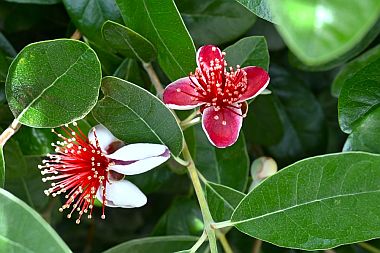
Feijoa Growing Conditions
Soil : Feijoa does better in organic soil. The fruit plant has been observed to do best in soil that is good in pH of 6.2 in it.
Drainage : The plant does not need much of watering. Water it only when the soil surface gets dry. Proper drainage is very important for feijoa shrubs. It is drought resistant but cannot tolerate standing water.
Climate : Feijoa requires low humidity, partial sun, and partial shade. It can tolerate it needs an annual rainfall of 762mm to 1016mm. The plant can tolerate lower temperature about 12degrees to 15degrees F.
Sowing : Sow the feijoa seeds in a hole that is of equal depth of the root ball, twice of its size in width. Water the soil moist and then sow the seeds.
Fertilizer : The plant do not need fertilizer for its survival, but providing some from time to time increases the fruit production rate and enhances taste of the fruit also.
Pruning : Pruning the fruits delicately from the plant after harvest accelerates fruit productivity. The spent branches need to be removed regularly to make it look good and it is proven that well maintained plants bear better fruits than others.
http://www.onlyfoods.net/feijoa.html
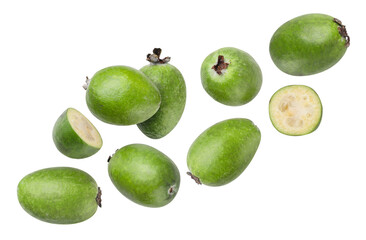
A bumper crop with high marks for health benefits
Feijoa growers are expecting a very high quality crop of fruit in near optimum condition as a result of the very warm summer. Feijoas are expected to be on sale by mid-March and available until early June this year.
Hot, dry weather is ideal for the production of a high quality crop and fruit quality for the season is looking very good, says the president of the New Zealand Feijoa Growers Association, Tim Harper. But it’s the world leading growing systems used by professional growers that will have played a key role in ensuring large, good quality fruit, he says and New Zealanders can’t necessarily expect to get comparable feijoas from the trees in their own back yards as a result of the warmer summer.
Not only is a good crop expected but the feijoa has been scoring very well in the analysis of its health benefits. In the growing trend for scientific research to demonstrate that eating fruits can reduce the incidence of chronic diseases including cancers, heart disease and stroke - the feijoa has given promising results.
In recent years research teams around the world have found extracts from the fruit to contain comparatively high levels of the compounds that enhance anti-inflammatory and anti-oxidant activity.
In one measure of antioxidant activity, the Horticulture and Food Research Institute of New Zealand (HortResearch) ranked feijoas just over mid-way in comparison with other popular fruit, confirming the potential for the fruit as a functional food ingredient.
The antioxidant activity of the fruit is based on their relatively high content of compounds known as proanthocynanins – a class of polyphenolics that are widely promoted for their health enhancing properties. The proanthocyanins have also been reported to reduce inflammation.
Based on their trials to date, scientific researchers agree there is evidence to support the use of proanthocyanin-based foods and dietary supplements as effective antioxidants. Although a high concentration of this compound usually makes for a bitter and astringent taste, it’s fortunate that they don’t impact on the flavour of feijoas.
Feijoas also have high levels of Vitamin C, and are high in minerals and fibre. Since an average feijoa contains around 9mg of vitamin C, just three a day will provide over half the recommended daily intake of vitamin C.
Although intensive research into this fruit is relatively recent says, Tim Harper from the growers association, the feijoa can justify its position as one of the healthiest fruits readily available to all New Zealanders.
He says confirmation of more good news on the benefits of the fruit and its extracts is expected to emerge soon from ongoing research.
http://www.scoop.co.nz/stories/BU0903/S00036.htm
How To Grow Feijoas
Mitre 10 Growing Guide
Feijoa trees grow well in subtropical regions, enjoying cool winters and moderate summers. They grow in a wide range of soils as long as there is good drainage and will flower and fruit best if planted in full sun.
Planting
You can plant feijoas all year round although autumn is the ideal time as it gives the tree roots a chance to establish over winter to be ready for growth in spring.
To plant, first prepare your soil by digging through with a garden fork, adding plenty of peat, compost or any well-rotted organics to top up the soil with nutrients.
Then follow these steps:
- Dig a hole, approximately twice the depth and width of the rootball of the tree.
- Half fill the hole and gently put the tree in place.
- Fill the hole to the top and compact in place.
- Water well and apply a layer of mulch
Handy Hint:
In windy areas it’s a good idea to tie the tree to a stake to give it some extra support while it is establishing.
Care and Maintenance
Once established, feijoa trees are drought-tolerant, but for quality fruit, you will need to water heavily on a regular basis during flowering and fruiting.
Feijoa trees have a shallow root system, so avoid cultivating (digging) around the roots.
Feijoa trees are gross-feeders (plants that need extra fertiliser), but as they are relatively slow growing they only need a light dose of general garden fertiliser or citrus fertiliser in early spring and again in late summer.
Mulching around the tree in autumn will help retain soil moisture. Remember to leave a gap around the tree trunk as if mulch touches the tree it could cause it to rot.
Pruning is not essential maintenance for a feijoa tree, but it will encourage new growth. As fruit forms on the current season’s growth, pruning will help to keep the tree productive. If you have planted a feijoa hedge, they do respond to trimming.
Always uses sharp shears to prune as this will ensure the cut is clean and reduce the chance of disease.
Pollination and Fruiting
Feijoa trees will produce a red pohutukawa-like flower in November/December. Birds pollinate the flowers as they eat the petals. Bees may also be pollinators. Unless the tree is self fertile, two or more trees should be planted together for cross-pollination. Feijoa fruit mature in late autumn/early winter.
Handy Hint:
Watch for a late frost in spring when the trees are in bloom, as this will damage flowers and ultimately fruiting.
Fruit should be collected from the ground rather than picked from the tree.
Troubleshooting - Poor Fruiting
- Inadequate pollination is the most common cause of poor fruiting.
- Heavy pruning will reduce flowering and fruiting.
- Root damage from cultivating (digging) around the roots will affect the tree.
- Cutting grown varieties produce less uniform fruit and have a lower yield.
- Although Feijoa trees are drought tolerant, you still need to water them deeply on a regular basis (especially during flowering and fruiting) to get the best results.
Click on their link to see comparison of varieties!
http://www.mitre10.co.nz/guides_and_advice/gardening_guides/how_to_grow_feijoas
Feijoa FAQ
Not Flowering
I purchased from Mitre 10 Taumaranui almost two years ago 8 bushes. It states that I do not need another variety as they are self-pollinating. I have just read in the latest Palmers that the only reliable variety that is Self-pollinating is UNIQUE.
Is this why mine have never flowered or fruited?
They are planted as a hedge they are in very good free draining soil.
Look forward to your reply, Thank you
This is very hard to understand. Firstly are these plants incredible edibles®? As all our plants are cutting grown or grafted plants, it makes me think because they have not flowered that they are seedling plants. If they are our plants has the top plant died and the rootstock is only growing? The rootstocks are grown from seeds.
Apollo is a semi self-fertile plant and with any feijoa in an urban situation because the birds pollinate them, they will cover a large area and pollinate between several gardens. But pollination is not a problem because you are not getting the flowers.
I did wonder if you were pruning wrongly as the flowers are borne towards the base of currents seasons shoot growth. But this would be very hard to do. If you were pruning too hard you would still get the odd flower.
I then did wonder if your temperatures were too cold but the flowers are not affected by very cold spring so this is not an issue.
Feijoas are one of the easiest plants to grow so it makes us think that your plants are seedlings as seedlings can take many years to flower and fruit.
I would love to hear any comments about the above as it is an unusual situation.
Pollination
Hello, I bought 2 new feijoa Wiki Tu trees a year ago (about 1m high) and they flowered but fruit didn't set. I had intended to get 2 different varieties and the nursery lady suggested that I get the same variety so they flower at the same time to pollinate, but I am now wondering if this was correct advice. Can you please advise me as I do want to get the trees producing as soon as possible and if it means getting a third tree I will do so and perhaps you could advise the variety I should get.
Feijoa Wiki Tu is not self-fertile so it needs another feijoa variety for pollination. But if you live in an urban situation a feijoa in another garden will help pollinate your plant. They are pollinated by birds.
Other varieties I would suggest if you are going to buy another plant would be one of the following; Apollo Golden Goose Kakapo Karamea Marion These varieties all will flower at the same time.
Fast Fruit
You can see where we live. It is in a unit with a very sunny back yard. My wife ; bless her heart ; would just love a feijoa tree. Can you please take a minute or two of your time and provide some advice. What variety that gives the quickest return ; we are not young ; Do you suggest we get. I have all the info from your web site. How long do we have to wait before we obtain fruit? I used to belong to a golf club that had about 6 feijoa trees ; the new green keeper came along & pulled them all out!!! What a riot!!!
Thank you for your enquiry. Feijoas take about 3 years to fruit. The yield will increase as the tree grows.
I have attached the feijoa chart for you. I do not know a variety that fruits quicker than the others. I would suggest if you are buying several plants that you buy plants that fruit at different times of the season so you have fruit for a longer period. Sorry we are unable to sell to you unless you are a garden centre or commercial grower. I suggest you contact either Mitre 10 or Bunnings where you live and ask them to order the plants for you. I hope this helps a little. If there is anything else I can help you with let me know.
Not Growing or Fruiting
Good morning I purchased 2 plants of yours from Mitre 10 back in 2005. One was Apollo and the other Kakapo. To date they have only grown to 850cm & 900cm respectively. Neither have fruited, although they both flowered (about 3 or 4 flowers each) for the first time last summer. I was hopeful fruit would develop, but nothing!!
I live about 200m above sea level in the Suburb of Maungaraki & admittedly they do cop the northerly wind (I have wind breaks in place). I have recently purchased another (Karamea I think)and planted this in the middle, in the hope of cross-fertilisation. Any advice you could give me, as to what could be wrong, would be much appreciated. I am very much a novice at growing fruit trees. Thank you for your reply. If I dig up the plants, will that kill it, or can it be re-planted? The soil is definitely clay. We do get a lot of birds out the back esp' natives, but I planted the trees on the front lawn near the foot path and road.
This is very strange. These two plants should complement each other flowering wise. But what I find strange is that they have hardly grown. I suggest you dig up one of your plants and tell me what their roots are like. I wonder if the roots were not teased apart when planted and are growing around and around. Yes the wind can be a factor if your plants are exposed to very strong winds. Can you send me some photos of the plants and others around it? Pollination is by birds - do you have plenty of birds in your garden? I am interested to hear more.
I think we need to look at the roots as it is a concern why the plants are not growing. Dig a large hole and carefully remove some soil to look at the roots. You do not need to take the whole plant out but need to get down and look at the roots.
If your soil is all clay this could be the issue, restricting the roots from growing and maybe keeping wet all the time. I am only surmising as I cannot see your plants.
Feijoas will grow in almost any soil type and grow best in slightly acidic conditions. Their fibrous root system penetrates soils easily and even heavy soils with fine particles are fine for them to grow in. High alkaline soils as in the case of clay has a high pH and this can cause yellowing of leaves and stunted growth. This soil condition can be altered if this is the issue with your plants.
Discuss with an experienced local garden retailer your problem and my comments above. They should be able to advise you if what I am saying is correct for your situation and the fact that clay soils and high pH is an issue in your area. If this is found to be the case then they should be able to advise you on a course of remedial treatment to bring your pH down to a suitable level.
FEJOAS WILL SOMETIMES GROW IN TEMPORATE ZONES. IF YOU FOLLOW MITRE 10's ADVICE, YOU SHOULD BE FINE!