Skip to content

By Katie Brenneman  
A passionate Writer specialising in lifestyle,
mental health and fitness-related content.

Vision Related With Mental Health

We all know that maintaining eye health is important, Indeed, potential vision loss is often one of the most feared aspects of ageing. It’s not difficult to understand why. The impacts of vision loss on daily functioning are obvious. What may not be so obvious, however, is how close the relationship is between your eyes and your mental health.

The Link Between Your Eyes and Your Brain

Physicians and researchers alike increasingly recognise the eye as an extension of the human brain. After all, the optic nerve that rests behind the eyeball forms a direct route into the deepest, oldest, and often the most instinctive and “emotional” parts of the brain.

The interconnectedness of the eyes and the brain lends credence to new and increasing evidence that the eyes can signal the presence not only of physical illness but the presence of mental illness as well.

For example, research suggests that optometrists may be able to detect signs of undiagnosed schizophrenia, presumably due to electrical anomalies characteristic of the illness that can be detected in the eyes’ pupillary reactivity.…

Here is a Genuine Professional who doesn't pull gimmicks. He had Arthritis really bad - found a Cure with the Paleo Diet and pressed on to see if a Natural Diet could Help against AMD. His Instincts proved right and he Pioneered this work some years ago. It works for Preventing AMD and is also known to Cure it in Early Stages. You may like to read about him and see a Video by him on this Page. I've also placed some direct Amazon Links to his Book in this Post. And no, I am not an affiliate:)

Ancestral Dietary Strategy to Prevent and Treat Macular Degeneration

Chris A. Knobbe, MD is an Ophthalmologist and Associate Clinical Professor at Emeritus, formerly of the University of Texas Southwestern Medical Center, in Dallas, Texas. Dr. Knobbe, a native of Colorado, graduated from the University of Colorado School of Medicine in 1990, completed a transitional internship at Denver Presbyterian/St. Luke's Medical Centers, and then a three-year Ophthalmology Residency at the University of Colorado Health Sciences Center, in Denver. After seven years in private practice, Knobbe joined the University of Texas Southwestern Medical Center as an Assistant Clinical Professor, a position he held until 2017.…

Hi there, these are two Articles for this Post - one on Chives and one on Parsley in the Interest of Better Health. I trust that many of you will give Chives and Parsley a try and maybe inspired to Grow some Organically too.

The Garden Herb that Experts say Boosts Immune Health
and Protects your Vision

Herbalists may Recommend them for Digestive Health,
Supporting the Immune System, and as a Mild Diuretic

Chives are a longstanding favorite in cream cheese, omelettes, scrambled eggs and spreads. But did you know the popular, slightly peppery-tasting herb comes with some major health benefits?

Just a tablespoon of the thin green vegetable – which some may mistake for the stronger-tasting, thicker green onion – helps to provide essential vitamins and minerals that strengthen eye health, and support a well-regulated gut and immune system.

Chives contain antibacterial and antiviral compounds, according to a handful of past studies published since the early 2000s.

“In modern herbalism, chives are used for their mild antiseptic and anti-inflammatory properties. Herbalists may recommend them for digestive health, supporting the immune system, and as a mild diuretic,” botanist Dr.…

And this is only Part of the Story of Vital Questions they are Not ASKING US and Vital Guidelines they are Not Giving Us that are Imperative for the HEALTH of Our Precious EYES.

What's the reason for this? They're only into SELLING GLASSES basically which have several hundred percent markup on, someone informed us on YouTube several years back who left that line of work.

So I'm Calling Them Out for not only their Outrageous Profits but for not asking us how much SCREENTIME do we Subject our Eyes to each Day and Evening, and do we punish our eyes with Too Much BLUE LIGHT Exposure from Excessive Screen Use.

It would also be of immense benefit to Most of Us if they gave us a Printout of something like the following. My word it would, because the more you research Vision and Eyecare, you see it has a LOT to do with DIET. If you read on, you will see why. And it will make plenty of sense. Shall we go?

What’s the Worst Food for your Eyes? Beware of These 5

Does what I eat affect what I see?…

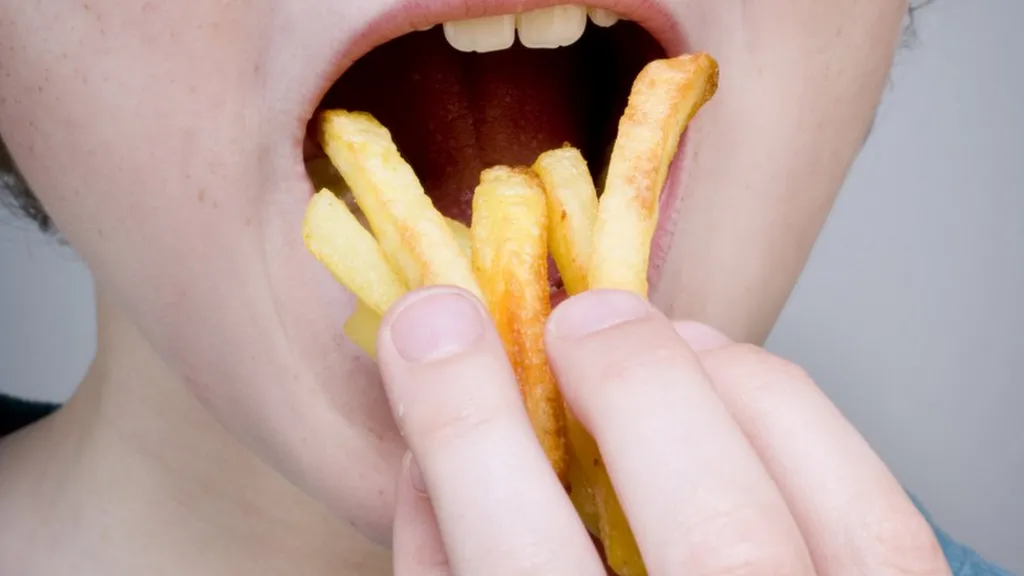
Experts are warning about the risks of extreme restrictive eating after a teen developed permanent sight loss after living on a diet of chips and crisps.

Eye doctors in Bristol UK cared for the 17-year-old after his vision had deteriorated to the point of blindness.

Since leaving primary school, the teen had been eating only French fries, Pringles and white bread, as well as an occasional slice of ham or a sausage.

Tests revealed he had severe vitamin deficiencies and malnutrition damage.

Chips and Junk Food are BAD for Our EYES

Malnourished

Three years later, he was taken to the Bristol Eye Hospital because of progressive sight loss, Annals of Internal Medicine journal reports.

Dr Denize Atan, who treated him at the hospital, said: "His diet was essentially a portion of chips from the local fish and chip shop every day. He also used to snack on crisps - Pringles - and sometimes slices of white bread and occasional slices of ham, and not really any fruit and vegetables.

"He explained this as an aversion to certain textures of food that he really could not tolerate, and so chips and crisps were really the only types of food that he wanted and felt that he could eat."…

HI FRIENDS, IT'S AFTER MIDNIGHT HERE BUT I'M SO STIRRED and INSPIRED TO START A SHORT SERIES OF ARTICLES FOR THE HEALTH OF OUR EYES and IMPROVED VISION plus SAFETY MEASURES OVER COMING WEEKS IN OCT-NOV 2025. I HOPE THIS HELPS MANY PEOPLE.

A common vitamin supplement could slow down the progression of the degenerative eye disease glaucoma, a study has found.

Vitamin B, found in whole grains, dark leafy greens, such as kale and broccoli, eggs, fish and dairy, appears to diminish the damage caused by the condition.

Glaucoma, which is suffered by nearly 700,000 people in the UK, is caused by an abnormality in the eye’s drainage system causing fluid to build up, increasing pressure on the optic nerve.

Primarily affecting older adults and those with a genetic disposition to the condition, it causes blurred vision and even blindness if left untreated. 

Glaucoma is usually managed by reducing the pressure through eye drops, surgery or laser treatments.

The researchers gave supplements of vitamins B6 (Pyridoxine - avoid Synthetic OR High Doses) B9 (Folate - avoid Folic Acid) and B12 to rats and mice with Glaucoma.…

2

As a Passionate Natural Health Researcher and CEO of Several Websites and Creation with a Passionate Care and Concern for Others Health and Happiness,
I was so into everything of long hours duration on a daily basis including many half nights and weekends. I do find my Work of Creativity and Research VERY INTERESTING to the point where I could “Live on Air” so to speak, neglecting meals often when I start a Project and work right through till I finish it – regardless of my Own Personal Health Needs, so Vital in Life for ALL of Us, not some of us.

PLEASE CARE FOR YOUR EYES!

Funny thing is, as an Inspirational Writer and Spiritual Writer, I really believe in “Practicing what I Preach” that for me is the Golden Standard – and I will not Compromise with that, as like many of you out there, I dislike Hypocrisy in any shape or form, be it religious, political or other. Yet when it comes to Health, I do Practice what I Preach – when it comes to things which are Vital and Essential – but looking back now, I wasn’t Fully practicing my Beliefs as a Researcher when it comes to My Own Health really.…

By Janet Vargas - Independent Natural Health Researcher 30+ Yrs

Unable to sleep at night after you've finished your programs for the evening? The Blue Light emitted from the Screen has Affected your Melatonin Levels for the night. Maybe your Kids can't sleep after their share for the same reason? Maybe you were a bit distracted by what's on the Screen to tuck your younger Kids into bed at night - their little minds could be thinking "Why doesn't mummy (or daddy) stay with me? Why does she (or he) go so quickly?" And even your Teenage Kids could be thinking they're no competition to that mesmerizing TV of yours. That is, unless they're off in their own rooms with their own TVs and it's the other way round. You're wondering if that was such a good idea, buying that 2nd TV or everyone their TVs.

TVs can Change your Priorities; TVs can make you Lazy to get up and Attend to things or even Loved Ones; TVs can even blunt your Sensitivity to them; TV can Infiltrate your thinking habits, so you have little Interest or Motivation for anything else; TV can cause you to Compromise your Commitments or even your Morals; TV can talk you into buying things you really didn't Need and you're wondering why you bought them?…

 By Maureen Salamon from WebMd.Com 2020

Have you ever woken up to bright morning skies feeling energized? A big reason for your mood is the high-intensity blue light coming from the sun. Among the visible light spectrum, blue wavelengths have the most powerful effect on your sleep-wake internal body clock.

Both natural and artificial blue light can boost your alertness and mental sharpness. But too much of it may keep you awake when your body needs to wind down.

Sunlight

Need help waking up in the morning? Open the blind or get outside to feel more alert.

Light From Screens

Their “blue” light has a powerful effect on your brain. Turn them out about 2hrs before bed.

Artificial Light

Bright lights after dark signal our brain to wake up. In the evening. In the evening. Use dim light, and block outside light.

Block Out Light To Get Good Sleep

How Blue Light At Night Hurts Sleep

Your eyes aren’t good at blocking blue light. So almost all of it passes straight through to the back of your retina, which helps your brain translate light into images.

Exposure to all colors of light helps control your natural sleep-and-wake cycle, or circadian rhythm.…

by Helen Carter, Journalist, Optometry Australia 2020

Another great reason to keep up physical exercise has now been added to the list. Several studies have provided evidence that regular physical exercise reduces the risk of age-related cataracts.

Regular Exercise Proves Beneficial For Eyesight

Australian and Chinese researchers analysed data from six different studies of more than 171,000 people looking at how exercise reduces oxidative damage in the eye. The studies included 19,173 cases of cataract. Participants from America, the UK and Sweden were followed for six to 12 years.

The research found that exercise appears helpful in cataract prevention, as well as being beneficial for other eye conditions including possibly reducing risks of developing glaucoma and age-related macular degeneration (AMD), plus delaying progression of AMD and diabetic retinopathy.

Researchers found a 10 per cent reduction in age-related cataracts among people who engaged in regular physical activity such as walking and cycling. And they said the risk of developing cataracts could potentially decrease by two per cent for every hour of cycling or jogging.

The researchers from the University of South Australia and Xi’an Jiatong University, China, published their findings in the International Journal of Ophthalmology.…